

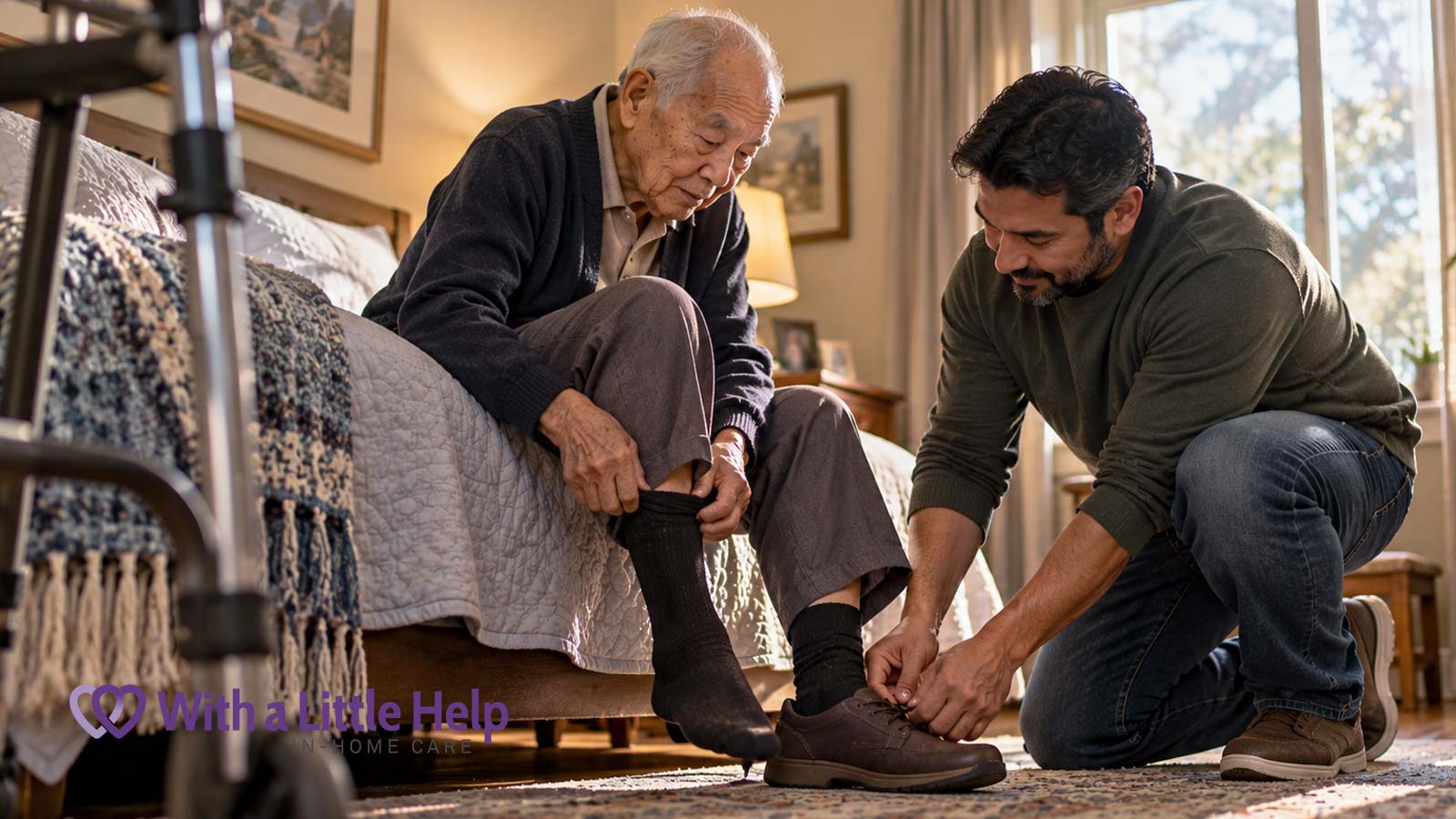
01 Oct Personal Care at Home: Helping Seniors With Bathing, Dressing, and Toileting
There is a peculiar moment in many families when nobody quite knows what to call the problem.
Dad is still Dad. He makes his own decisions. He watches the Mariners, complains about Seattle traffic, pays his bills, and knows exactly how he likes his coffee.
But he hasn’t showered in a week.
Or Mom still gets herself dressed every morning, except now she wears the same clothes for several days because buttons have become difficult. Maybe she has started avoiding the upstairs bathroom. Perhaps her daughter discovers that getting on and off the toilet has become much harder than Mom has admitted.
These aren’t housekeeping problems. They aren’t necessarily medical problems either.
They are personal care needs.
Personal care means assistance with the private, everyday activities people have handled for themselves for most of their lives: bathing, dressing, grooming, toileting, eating, and moving around safely. Healthcare professionals often call these activities of daily living, or ADLs.
Needing help with them can feel like a major change. Providing that help can be difficult for families too.
Done well, personal care isn’t about taking over. It’s about providing enough assistance for an older adult to continue living safely, comfortably, and with as much independence as possible.
Personal Care Is More Than “Helping With a Shower”
When families first contact an in-home care agency, they may describe the problem in very specific terms.
“Mom needs someone to help her bathe.”
But bathing rarely exists in isolation.
Getting ready for a shower might require standing from a chair, walking to the bathroom, undressing, stepping safely into the shower, washing, getting out, drying off, getting dressed again, and returning to another room.
Difficulty at any point can turn an ordinary morning routine into something exhausting or unsafe.
Personal Care Can Include Help With:
- Bathing and showering
- Dressing and undressing
- Grooming
- Toileting and incontinence care
- Getting into and out of bed
- Moving safely around the home
- Oral hygiene
- Eating and other everyday routines
These are widely recognized as core personal care activities for older adults living at home.
The amount of help can vary enormously. One senior may need someone nearby while showering. Another may need hands-on assistance with several parts of the routine.
The objective should be the same: help with what the person needs without unnecessarily taking over what they can still do themselves.
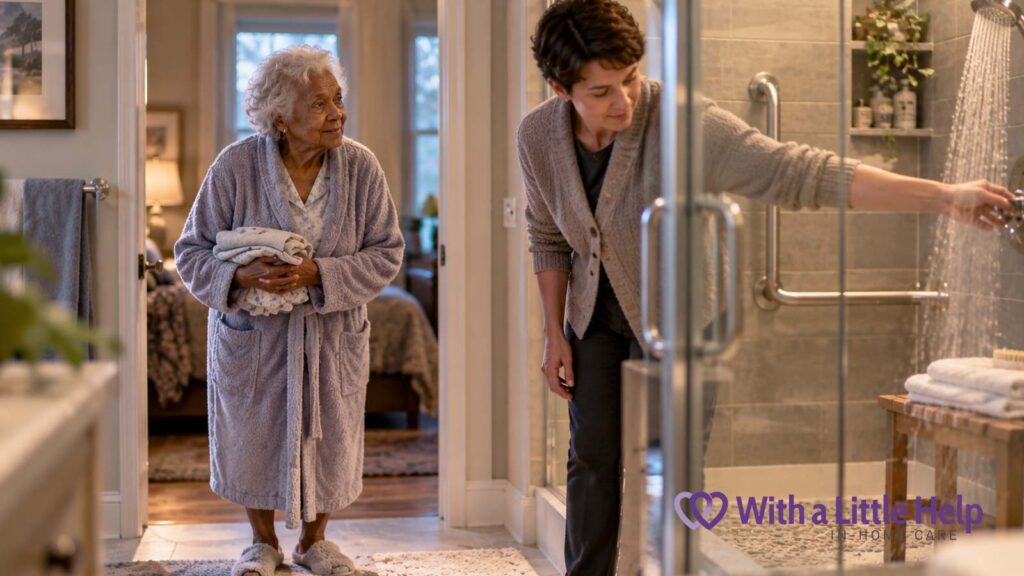
Bathing Can Become Difficult Before Anyone Talks About It
Bathing is one of those activities that can quietly change.
A senior may start showering less frequently. They may switch to washing at the sink. They may insist they already showered when they didn’t.
Sometimes memory is involved. Often, the explanation is much simpler.
The shower has become difficult.
Why Seniors May Begin Avoiding the Shower
Consider what bathing actually requires physically.
You have to remove your clothes while maintaining your balance. Step over or around a shower threshold. Stand on a wet surface. Reach different parts of your body. Close your eyes while washing your hair. Bend. Turn. Then reverse the whole process while you’re wet.
The CDC specifically recommends bathroom safety measures for older adults, including grab bars inside and outside tubs and showers, grab bars near toilets, nonslip surfaces, and adequate lighting.
A Seattle winter can add another small barrier. On a dark, cold morning, getting undressed and stepping into a shower may feel considerably less appealing to someone who already finds the process tiring or uncertain.
Avoidance can make perfect sense from the senior’s point of view.
Personal Care Can Provide the Missing Support
A caregiver can provide appropriate assistance based on the senior’s abilities and care plan.
For someone who can still bathe mostly independently, that may mean preparing the bathroom, making sure necessary items are within reach, and providing support with getting into or out of the shower.
Another person may need more direct help with bathing and drying.
We always strive to preserve as much independence as possible, particularly for people living with Alzheimer’s disease or other memory changes. Someone who can still wash part of their body, for example, can continue doing so even if they need assistance with the rest.
That principle applies well beyond dementia care.
Being able to do something yourself still counts, even when you need help with the next step.
Dressing Is an Everyday Test of Strength, Balance, and Dexterity
Getting dressed looks simple until arthritis makes buttons painful.
Or shoulder mobility declines.
Or bending far enough to put on socks becomes difficult.
Or standing on one leg long enough to pull on a pair of pants becomes a genuinely bad idea.
The Goal Isn’t to Dress Someone Who Can Dress Themselves
Personal care should fill the gap.
Maybe Dad chooses his clothes and puts on his own shirt but needs help with socks and shoes.
Mom may dress herself if someone lays out the clothes she wants and gives her enough time.
Someone with dementia may need a simpler sequence, fewer choices, or one item handed to them at a time. We use approaches like laying clothing out in order and using simpler fasteners when dressing becomes difficult for someone with Alzheimer’s disease.
The caregiver’s role can change as the senior’s abilities change.
That’s what personalized care should do.
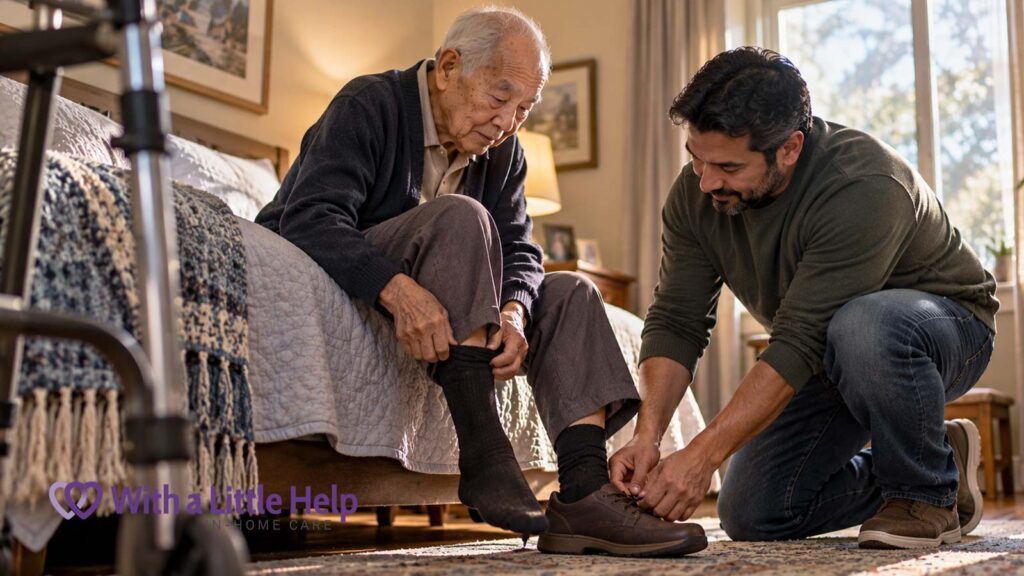
Let’s Talk About Toileting
Families often find this the hardest personal care topic to discuss.
So it helps to be straightforward about it.
Yes, in-home personal care can include assistance with toileting and incontinence care.
For some seniors, the main problem is mobility. They can manage toileting once they’re in the bathroom but need help getting there safely or getting on and off the toilet.
Others need more hands-on assistance with clothing, hygiene, changing, or other personal care.
These are ordinary human needs. Professional caregivers deal with them as part of caring for people.
Bathroom Safety Is Part of the Picture
Toileting often combines several potential difficulties at once: urgency, reduced mobility, clothing that needs to be managed, sitting and standing, and navigating a bathroom that may not have been designed for an older adult.
That’s one reason bathroom safety deserves attention.
Grab bars near the toilet can provide additional support, while better lighting and fewer obstacles can make the route to the bathroom safer.
For a senior who needs physical assistance, environmental improvements and personal care can work together.
Dignity Isn’t a Separate Service
The word dignity gets used so often in senior care that it can start sounding like marketing language.
Here, it has a very practical meaning.
Knock before entering.
Close the bathroom door.
Explain what you’re doing.
Don’t expose someone unnecessarily.
Let them do the parts they can still do.
Respect preferences about clothing, bathing routines, grooming, and privacy.
Don’t talk over them as though they aren’t in the room.
Personal care involves crossing boundaries that most adults have maintained for decades. Bathing and dressing can be embarrassing or upsetting precisely because these are activities people have historically performed in private.
A caregiver may perform the same task hundreds of times professionally.
For the person receiving help, it is still personal.
Sometimes Professional Personal Care Is Easier Than Family Care
A daughter may love her father deeply and still not want to help him shower.
He may be even less enthusiastic about the arrangement.
That isn’t a failure of their relationship.
In fact, the relationship is exactly why it can be uncomfortable.
Family Roles Don’t Disappear When Care Needs Increase
For 50 years, Mom has been Mom.
Now her son is trying to help her use the toilet.
Both people may understand intellectually that there’s nothing shameful about it. That doesn’t mean either one feels comfortable.
Spouses can face a different challenge. Personal care may feel completely natural between partners, but the physical demands can eventually exceed what one older spouse can safely manage.
An 82-year-old husband may be devoted to his wife. That doesn’t automatically make him the right person to help lift or steady her several times a day.
Professional personal care can preserve some boundaries.
A caregiver handles the caregiving task. The daughter gets to be the daughter again.
Memory Loss Can Change Personal Care Needs
Dementia adds complications that have little to do with physical ability.
A person may still be capable of taking a shower but forget when they last bathed. They may put several shirts on and no pants. They may become confused about the sequence of getting dressed or resist help because they don’t understand why another person is in the bathroom.
Familiarity and Routine Can Help
For someone with memory loss, consistency can make personal care easier.
The same bathroom. The same morning routine. Familiar toiletries. Familiar clothes. A caregiver they recognize.
The National Institute on Aging recommends predictable routines, simple choices, step-by-step guidance, and allowing the person to participate as much as possible when helping someone with Alzheimer’s bathe or dress.
For a senior who has lived in the same Seattle-area home for decades, those familiar surroundings can provide useful cues even as memory changes.
The routine may need to adapt, but it doesn’t necessarily need to move somewhere else.
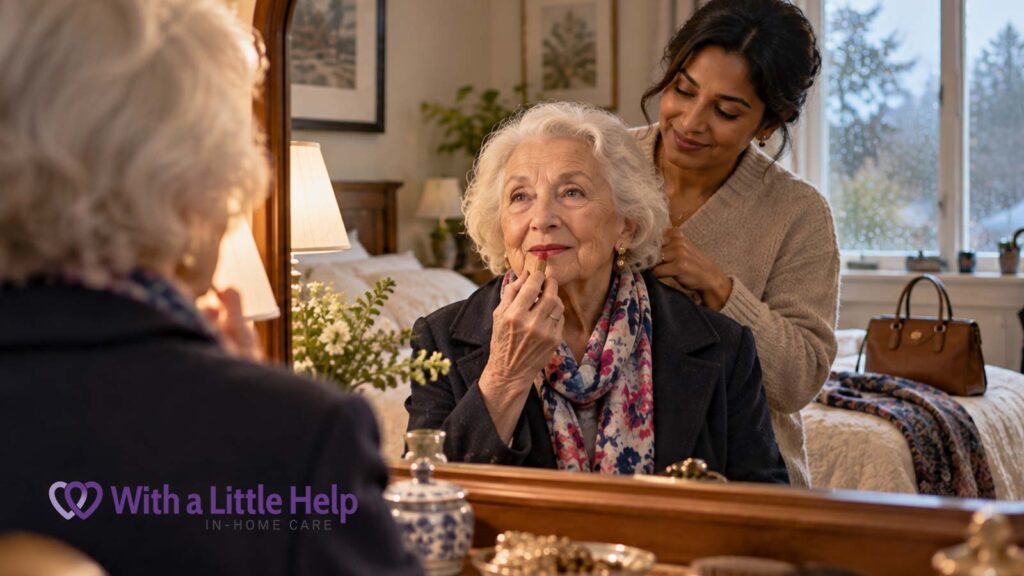
How Do You Know When Someone Needs Personal Care?
Sometimes the senior asks.
Often, they don’t.
Families may notice smaller clues first.
Watch for Changes, Not Just Crises
- Wearing the same clothes repeatedly
- Body odor or declining hygiene
- Hair or oral care being neglected
- Avoiding showers or baths
- Difficulty with buttons, zippers, socks, or shoes
- Unexplained bruises that could suggest balance problems
- Holding onto furniture while moving around
- Difficulty getting on or off the toilet
- Soiled clothing or bedding
- Frequent nighttime bathroom problems
- A spouse struggling physically to provide assistance
- Increasing anxiety around bathing or dressing
One sign doesn’t automatically mean someone needs professional personal care.
Patterns are more informative.
If several everyday activities have become harder, it’s worth looking at what kind of help would make those routines safer and less stressful.
Personal Care Doesn’t Have to Mean Giving Up Independence
This is one of the biggest misconceptions about accepting help.
Independence isn’t an all-or-nothing condition.
A person doesn’t become “dependent” because someone helps them into the shower twice a week.
In fact, accepting targeted help can preserve independence in other areas.
If bathing assistance reduces the risk of a fall, that may help someone continue living at home. If help with dressing means Mom can still get ready for lunch with friends, the assistance supports her independence rather than taking it away.
Personal care should expand what someone can safely continue doing.
Personal Care Can Start Small
Not everyone needs hours of hands-on assistance every day.
A senior may initially need personal care during only a few scheduled visits each week. Those visits might combine bathing or dressing assistance with meal preparation, laundry, companionship, errands, or transportation.
Over time, the balance can change.
Maybe morning routines become harder. Perhaps a hospitalization temporarily increases care needs. Memory loss may progress. A spouse who previously helped with personal care may no longer be physically able to do so.
That flexibility is one of the advantages of receiving personal care at home.
Personal Care Is Part of a Larger Senior Care Plan
Bathing, dressing, and toileting don’t happen in separate little boxes.
They’re part of someone’s day.
A caregiver might arrive in the morning and help a senior get out of bed, use the bathroom, shower, choose clothes, get dressed, prepare breakfast, and settle in with the newspaper.
Later, they might go to an appointment or grocery shopping together.
That’s personal care, but it’s also companionship, mobility assistance, meal preparation, transportation, and everyday life.
Personal care is one part of the broader support that can help older adults continue living at home.
The care plan should reflect the person rather than forcing the person into a service category.
Asking for Help With the Most Personal Things
Nobody grows up looking forward to the day when someone helps them put on their socks.
Most people would rather keep doing these things themselves.
That is precisely why good personal care should preserve independence wherever possible. Help with the difficult parts. Make the unsafe parts safer. Respect privacy. Learn the person’s routines. Let them remain in charge of the decisions they can still make.
Sometimes a relatively small amount of assistance is what allows the rest of life at home to continue.
For a senior, that may mean showering safely, wearing the clothes they chose, getting out of the house, and spending another rainy Seattle morning exactly where they want to be: home.
If bathing, dressing, toileting, mobility, or other everyday routines are becoming harder for someone you love, contact With a Little Help to discuss personal care at home and a personalized care plan for your family.
