


28 Sep Overnight Care for Seniors With Dementia and Memory Loss
Nighttime can become complicated for someone living with dementia or memory loss.
A person who moves confidently through a familiar home during the day may wake confused about where they are. Someone who remembers to use a walker at breakfast may forget it at 2 a.m. A senior who usually asks for assistance may simply get out of bed without remembering that they’re supposed to call for help.
These changes can make nights difficult for the senior and exhausting for the family members trying to keep them safe. For Seattle-area families trying to help a parent or spouse continue living at home, nighttime can become the part of the care plan that’s hardest to manage alone.
Overnight care for seniors with dementia provides another option. A caregiver can remain in the home during nighttime hours, helping with safety, mobility, personal care, reassurance, and the unexpected things that happen after everyone else has gone to bed.
Why Dementia Can Make Nighttime More Difficult
Memory loss doesn’t affect everyone in the same way. Nighttime challenges also vary considerably from one person to another.
Some seniors sleep well most nights. Others wake frequently or become more confused as the day ends.
Confusion After Waking
Most of us have occasionally awakened and needed a few seconds to figure out where we are.
For someone with dementia, that confusion can be much more significant.
A senior may wake without recognizing the bedroom. They might think they need to get ready for work or pick up children who are now adults. They may believe it’s morning when it’s actually the middle of the night.
Trying to correct every detail isn’t necessarily the immediate priority. A calm, familiar presence can help reassure the person and guide them back into a safe nighttime routine.
Changes in Sleep Patterns
Dementia can disrupt normal sleep patterns. A senior may sleep more during the day, wake repeatedly at night, or become active at unusual hours.
Some people also experience increased confusion, anxiety, or agitation later in the afternoon and evening, often described as sundowning.
Whatever the cause, the practical problem for families is the same: someone may need attention at a time when the rest of the household needs to sleep.

Nighttime Safety Can Become a Concern
Memory loss adds another dimension to ordinary nighttime risks.
A senior doesn’t necessarily need to be physically frail to get into trouble. They may simply forget the habits and precautions that normally keep them safe.
Getting Out of Bed
A person who needs assistance getting out of bed may not remember that limitation after waking.
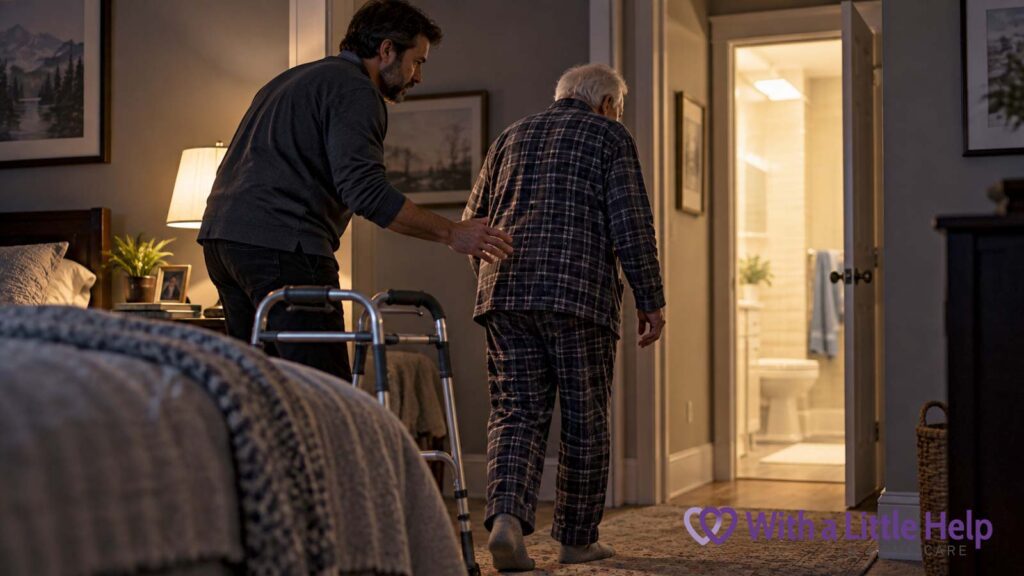
They might stand too quickly, forget their cane or walker, or attempt to cross a dark room without turning on a light.
An overnight caregiver can be there to provide the level of mobility support included in the senior’s care plan.
Seattle’s long winter nights can make this even more noticeable. A senior may go to bed after dark and wake several times before daylight, navigating a dim house while still groggy or confused.
Bathroom Trips
Bathroom trips are one of the most common reasons seniors need help during the night.
For someone with dementia, getting to the bathroom can involve more than mobility. They may wake disoriented, have trouble finding the bathroom, or become confused about what they’re doing once they get there.
Caregivers can assist with getting to and from the bathroom safely and provide appropriate toileting or personal care when needed.
Wandering
Not every person with dementia wanders, but it can become a serious concern for some families.
Nighttime wandering might mean moving repeatedly from room to room. In more concerning situations, a senior may try to leave the house.
They aren’t necessarily trying to “escape.” They may believe they need to go somewhere perfectly logical within their understanding of the moment.
Having someone awake and alert in the home can help families manage those situations without depending on the senior to recognize the danger themselves.
The Senior May Not Remember to Ask for Help
This is an important difference between overnight care for someone with cognitive impairment and care for someone whose needs are primarily physical.
A senior with mobility problems might know perfectly well that they shouldn’t get out of bed alone. They can use a call button or call someone’s name.
Someone with dementia may have received exactly the same instructions and genuinely agreed to them.
At 3 a.m., they may not remember any of it.
That means a nighttime care plan can’t always rely on the person recognizing when they need assistance.
What Can an Overnight Caregiver Help With?
Overnight care should reflect the individual senior’s needs rather than a standard checklist.
Depending on the personalized care plan, support may include:
- Monitoring for wandering or nighttime confusion
- Helping the senior get into and out of bed
- Assisting with bathroom trips and toileting
- Providing mobility support
- Reminding the senior to use a walker or other mobility aid
- Helping with repositioning and comfort
- Providing reassurance when the senior wakes confused
- Assisting with evening personal care and bedtime routines
- Helping the senior begin their morning routine
Sometimes the caregiver will be busy several times during the night. On another night, the senior may sleep peacefully for hours.
With awake overnight care, the caregiver remains awake and alert throughout the shift even when the senior is sleeping.
Familiarity Can Help
For someone experiencing memory loss, home itself can provide valuable cues. A senior may have lived in the same Seattle house for 30 or 40 years. They know the view from the bedroom window, the hallway to the bathroom, the creak in the stairs, and where they’ve always kept the coffee mugs.
The bedroom is familiar. The bathroom is where it has always been. The same pictures hang on the walls. The coffee mugs are in the same cupboard.
Familiar caregivers and predictable routines can add another layer of consistency.
Over time, a caregiver may learn how the senior normally prepares for bed, what tends to reassure them when they’re confused, whether they usually wake at certain times, and which routines make the night go more smoothly.
That knowledge can be particularly useful when dementia makes each day less predictable.

Overnight Care Also Helps Family Caregivers Sleep
Nighttime dementia care can gradually turn a spouse or adult child into an extremely light sleeper.
Every creak in the hallway gets attention. Every bathroom trip requires listening. A family member may wake several times simply to check that Mom or Dad is still safely in bed.
That can continue night after night.
Eventually, the effects show up during the day too. Exhausted family caregivers still have jobs, errands, appointments, children, and their own health to manage.
Overnight care creates scheduled hours when someone else can take responsibility for the senior’s planned nighttime support.
A spouse can sleep without keeping one ear open.
An adult child can return to their own home for the night.
That rest can make it easier for family members to remain involved and present during the hours they spend together.
Does Overnight Care Mean 24-Hour Care?
No.
Some seniors with dementia need extensive supervision throughout the day and night. Others remain fairly independent during daylight hours but need more support after dark.
With a Little Help typically provides overnight shifts of 8 to 12 hours, with schedules such as 8:00 p.m. to 8:00 a.m. or 10:00 p.m. to 6:00 a.m. Some clients benefit from longer shifts that include both evening and morning routines.
WALH also offers both awake overnight care and live-in care.
The appropriate arrangement depends on what the senior needs, how frequently they wake, whether they require active monitoring, and how much support the family is currently providing.
When Should Families Consider Overnight Dementia Care?
You don’t necessarily need to wait for a major nighttime incident.
It may be worth discussing additional support when a senior begins getting up unsafely, wandering, experiencing significant nighttime confusion, forgetting to ask for assistance, or requiring increasingly frequent help with bathroom trips and mobility.
Family exhaustion counts too.
If one person has become responsible for listening for movement throughout the night, responding whenever the senior wakes, and then functioning normally the next day, the current arrangement may not be sustainable.
Care needs can change gradually. Support can change with them.
Helping Someone With Dementia Remain Safely at Home
Memory loss doesn’t automatically mean someone has to leave the Seattle-area home and neighborhood they know. With the right level of support, many families can continue adapting care around changing needs rather than treating a move as the automatic next step.
Often the better question is how much support their loved one now needs to continue living there safely and comfortably.
Sometimes that means a few scheduled visits during the week. Sometimes it means daily assistance. And when nighttime becomes the difficult part, overnight care can fill a gap that family members can no longer reasonably cover themselves.
If nighttime confusion, wandering, mobility, or other memory-related concerns are making it harder for someone you love to remain safely at home, contact With a Little Help to discuss overnight care for seniors with dementia in Seattle and the surrounding communities.
